Tax Benefits CollegeCounts Offers Savings with Tax Deductions and Tax-Deferred Growth

Alabama Income Tax Deduction (up to $10,000) for Contributions1
Every year, Alabama taxpayers may be eligible to take advantange of a state income tax deduction on their contributions to a CollegeCounts 529 account up to:
- $10,000 for a married couple, filing jointly when both spouses contribute.
- $5,000 for single filers.
Keep in mind the contribution deadline for the Alabama state income tax deduction is December 31 each year.

Tax-Deferred Growth
Contributions and any earnings grow in the plan with no federal or state income taxes deducted each year, providing the potential for additional investment growth.
Tax Free Withdrawals for Qualified Higher Education Expenses
Your account assets can be used to pay for the Beneficiary’s Qualified Higher Education Expenses.
- Tuition, fees, books, supplies, and equipment required for enrollment or attendance of a Beneficiary at an Eligible Educational Institution;
- Room and board expenses (with certain limitations) incurred by students who are enrolled at least half-time;
- A computer, computer equipment, software, and Internet access and related services used primarily by the Beneficiary while enrolled;
- Special needs services in the case of a special needs Beneficiary which are incurred in connection with such enrollment or attendance;
- Apprenticeship Program Costs, including tuition, fees, books, supplies, and equipment required for participation;
- Qualified Education Loan repayments for the Beneficiary or their sibling, subject to a lifetime limit of $10,000 per individual;
- Qualified Elementary and Secondary Expenses2 (K-12) in connection with the Beneficiary’s enrollment or attendance at an elementary or secondary public, private or religious school, subject to an annual $20,000 per Beneficiary limit; and
- Qualified Postsecondary Credentialing Expenses3 such as tuition, testing fees, and materials for approved credential programs.
When using funds from your CollegeCounts 529 account, keep in mind that expenses must be directly tied to the education program. To ensure compliance, you can check with the institution or consult IRS guidelines (Publication 970) to find out whether specific costs qualify.

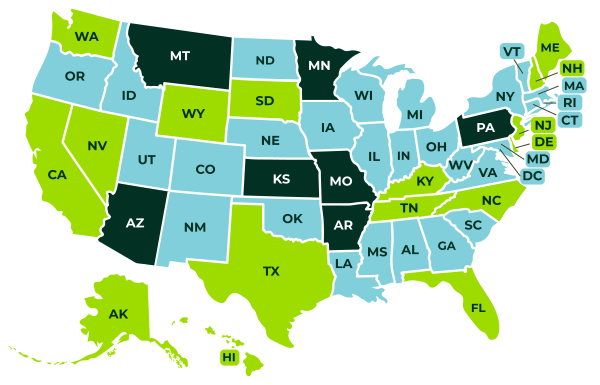
Tax-Parity States includes: Arizona, Montana, Minnesota, Kansas, Missouri, Arkansas
States that offer tax benefits for contributions to any state’s 529 plan.
Tax-Neutral States includes: Washington, California, Nevada, Wyoming, South Dakota, Texas, Alaska, Hawaii, Kentucky, Tennessee, North Carolina, Maine, New Hampshire, New Jersey, Delaware, Florida
States without state income taxes or other state benefits for investing in that state’s 529 plan.
Tax-Benefit States includes: Oregon, Idaho, Utah, Colorado, New Mexico, North Dakota, Nebraska, Oklahoma, Wisconsin, Iowa, Illinois, Michigan, Indiana, Ohio, Vermont, New York, Massachusetts, Rhode Island, Connecticut, Maryland, District of Columbia, West Virginia, Virginia, Louisiana, Mississippi, Alabama, Georgia, South Carolina
States where income tax benefits are only available for those who pay income tax in that state and own, or contribute to, that state’s 529 plan.
Tax Benefits for States Other Than Alabama
Families outside Alabama can also benefit from using a CollegeCounts 529 account to save for college. Some states offer their state income tax benefits to taxpayers of that state regardless of which 529 plan they choose. Those out-of-state investors can select any state’s 529 plan, including the low-cost CollegeCounts 529.
The low costs and diverse investment options from a number of respected fund families offered by CollegeCounts make it a leading choice for families outside Alabama.
Check the map to see how your state manages 529 contributions.
Before investing, investors should consider whether their or their beneficiary’s home state offers any state tax or other state benefits such as scholarship funds, financial aid, and protection from creditors that are only available for investments in such state’s qualified tuition program. Investors should also consult their tax advisor, attorney, or other advisor regarding their specific legal, investment, or tax situation.
Gift and Estate Tax Planning for 529 Plans
Contributions to a 529 plan are considered gifts from the contributor to the beneficiary (the future student who will use the funds). Funds in a 529 account are also generally excluded from the contributor’s taxable estate. If the beneficiary passes away, the account balance becomes part of their own estate—not the account owner’s.
As a 529 account owner, your contributions qualify for the annual gift tax exclusion, currently set at $19,000 per donee.
The IRS also allows for a unique five-year gift tax election for 529 plans. This provision permits a donor to contribute up to $95,000 per beneficiary in a single year without federal gift tax consequences, provided no additional gifts are made to that beneficiary in the same year or the following four years.
To use this option, you must file a federal gift tax return (Form 709). Be aware that if you pass away within the five-year period, a portion of the contributions may be added back to your taxable estate. Consulting a tax advisor is strongly recommended before making large contributions.Footnote Footnote 4